sharing is caring
Welcome to this blog post about an important topic close to our hearts: Hotel Marketing! It's not just an area of expertise for us; it's a passion that fuels our enthusiasm! So, let's dive into this subject. We'll explore the essence of marketing, debunk misconceptions, and unveil strategies tailored specifically to help small hotels and businesses to thrive.
As a hotel marketing agency, our initial step in any new collaboration is to establish a clear understanding of the dynamic landscape of marketing. It's essential to recognise that marketing has undergone substantial transformations over the past decades, adapting to changing consumer behaviours and technological advancements. Traditional marketing, the traditional method of developing, promoting and selling products or services, has been the cornerstone of marketing strategies for many years.
Initially focusing on the 4 Ps – Price, Product, Place, and Promotion – this approach has since evolved to encompass a broader spectrum and additional dimensions - like Physical Evidence, People, and Processes - forming what is commonly known as the 7 Ps.
However, it's crucial to acknowledge alternative perspectives in marketing. In 1973, Professor Koichi Shimizu introduced a paradigm shift with his innovative 7 Cs Compass Model. Unlike the company-centric focus of the Ps, the 7 Cs framework adopts a consumer-centric viewpoint, emphasising crucial elements such as Customer Value, Communication and Convenience (Carniel, 2022). This shift highlights the importance of aligning marketing strategies with the ever-changing needs and preferences of modern consumers.
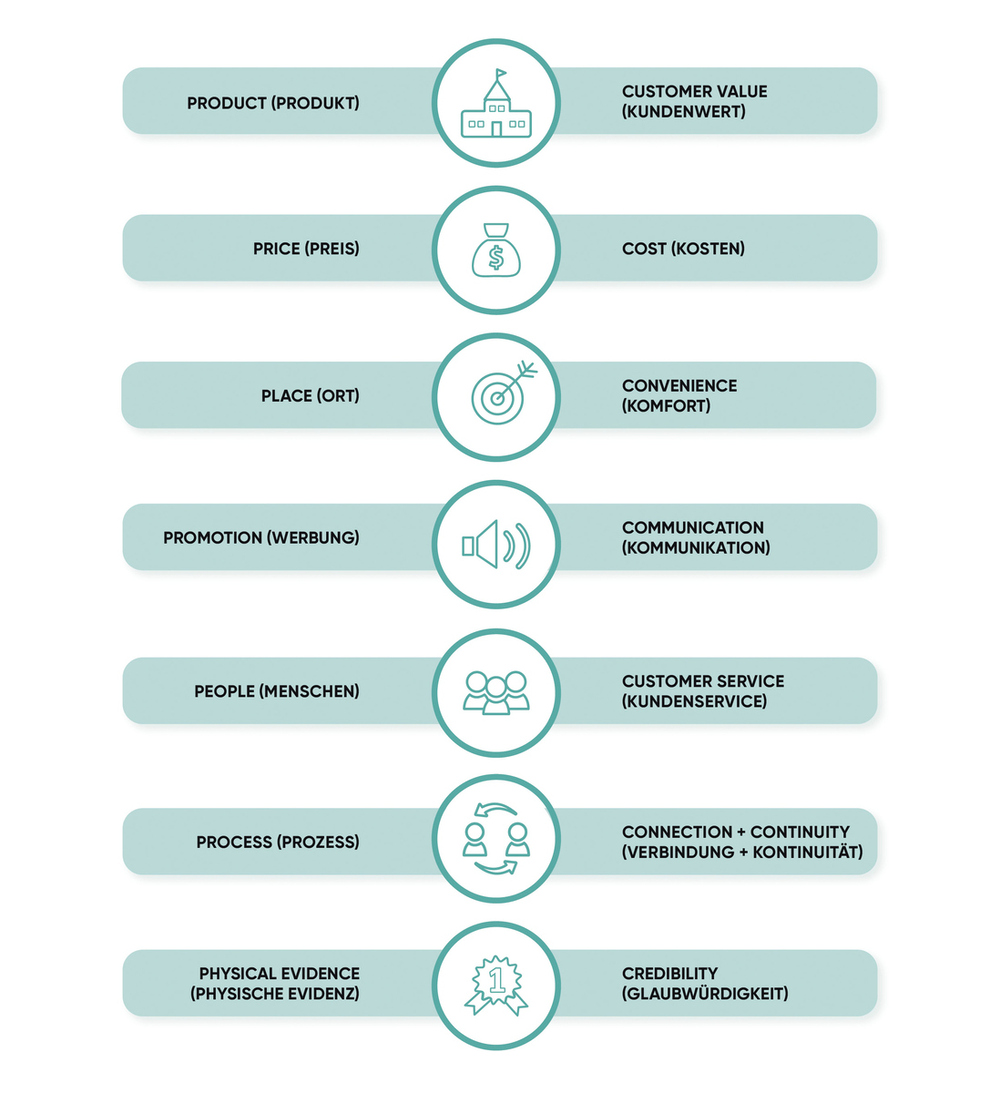

For decades, the P and C models helped hotels and businesses to define their marketing mixes and align their marketing activities with their respective markets (as implied by the very term “MARKETing”).
However, it became increasingly apparent that the essence of traditional marketing began to veer away from its original intent – to glean insights from the market, develop products and services tailored to meet market needs, and enhance overall market value. Instead, there emerged a growing reliance on persuasion and manipulative messaging to compel consumers to purchase products or services.
Over the last decades, however, new marketing thought leaders have reshaped the definition and perception of marketing. Seth Godin (2019) defines marketing as follows in his ground-breaking book “This is Marketing”:
Marketing is the generous act of helping others become who they seek to become. Instead of selfish mass, effective marketing now relies on empathy and service. Marketing is not a battle, and it’s not a war, or even a contest. Marketing is the generous act of helping someone solve a problem. Their problem. Effective Marketing is about understanding our customers’ worldview and desires so we can connect with them. It’s focused on being missed when you’re gone, on bringing more than People expect to those who trust us. It seeks volunteers, not victims.
1. Clearly define your hotel marketing budget
As a hotel marketing agency, we always say: you need to invest some money to make more money. And this totally applies to hotel marketing, where strategic investments yield substantial returns! Unfortunately, it’s too often that small and independent hotels never take the time to create a marketing budget.
Therefore, our MAdvice:
2. Hope is NOT a strategy
After defining your hotel marketing budget and your hotel marketing goals, it’s time to plan it out. Together with our clients, we start with a yearly plan and scheduling tasks, actions, outputs, per quarter. As a last step, we define top goals per month.
Our MAdvice: set monthly goals aligned with your quarterly goals. Be flexible about how you are going to reach them.
3. Don’t try to be everywhere – be specific
One of the biggest pitfalls we see hotels and small businesses fall into is trying to be “everywhere”. Let’s look at hotel social media to illustrate what we mean by this.
There are an array of social media channels out there, with every channel having its own rules, do’s and don’ts. All too often we see that hotel clients try to be on all of them, without realising that being specific and choosing the channels carefully, and planning the content out in detail on those important channels (= the channels your potential guests and clients are on), delivers much better results. Our guiding mantra at our hotel marketing agency is: Class over Mass!
Our MAdvice: choose your channels wisely, be focused and deliver the best content you can. Quality always wins in the long-run.
As we highlighted earlier in this blog post, marketing encompasses seven key functions, often represented by the 7 Ps or 7 Cs. Let's delve into one of these functions in this concluding section: communication. Traditionally, marketing communication has been characterised as loud, paid, persuasive, and sometimes manipulative. However, if you aspire to elevate your hotel marketing for sustainable success, we at MAp advocate for one overarching principle: sustainability.
Sustainable Communication means you are communicating in a socially-responsible and ecological manner, with no negative impact to society, the economy and the Planet. The objective of Sustainable Communication is therefore to reduce the environmental and social footprint of communication activities and to make sure that all can profit from them.
We’re convinced that the future of marketing (AND hospitality) is sustainable, and you can learn more on this topic here. As always, we extend our gratitude for your commitment to #neverstoplearning.
After reading this blog post, we encourage you to engage in marketing endeavours that you take pride in – ones that address People's needs and contribute to creating a better world for everyone!
Through our hotel marketing services, we position your independent and boutique hotel on the global MAp – in a unique, sustainable and authentic way.
 ke time for prosecco ke it happenke it meaningfulke good coffeeke it matterke funny jokeske it kindke it simpleke it count
Sign up for the MAp newsletter for practical insights on hotel branding, marketing, and sustainability, plus fresh thinking from our projects and new tools from our sustainability platform. Let’s move #onwards together.